I Built AirTag in 1998
GPS, mesh beacons and mobile data — for swap bodies
In 1998 I was a systems engineer at ELEKLUFT, building radar test systems for the German Air Force and NATO. In my spare time, I had a habit of building things — including a real-time status display for a Formula One circuit, showing the positions of rescue cars, safety cars, marshals and firefighters around the track.
During a visit to race control, the CEO of a transportation company saw the display and started talking about his own tracking problem: swap bodies — the interchangeable truck containers that logistics companies trade between each other and regularly lose track of. Thousands of them, scattered across depots, with no reliable way to know where any given unit was at any moment.
That conversation became TaPos — a semi-autonomous positioning system for exactly that problem.
The system was called TaPos (Teilautonomes Positionserfassungssystem). The architecture was simple and, as it turned out, ahead of its time.
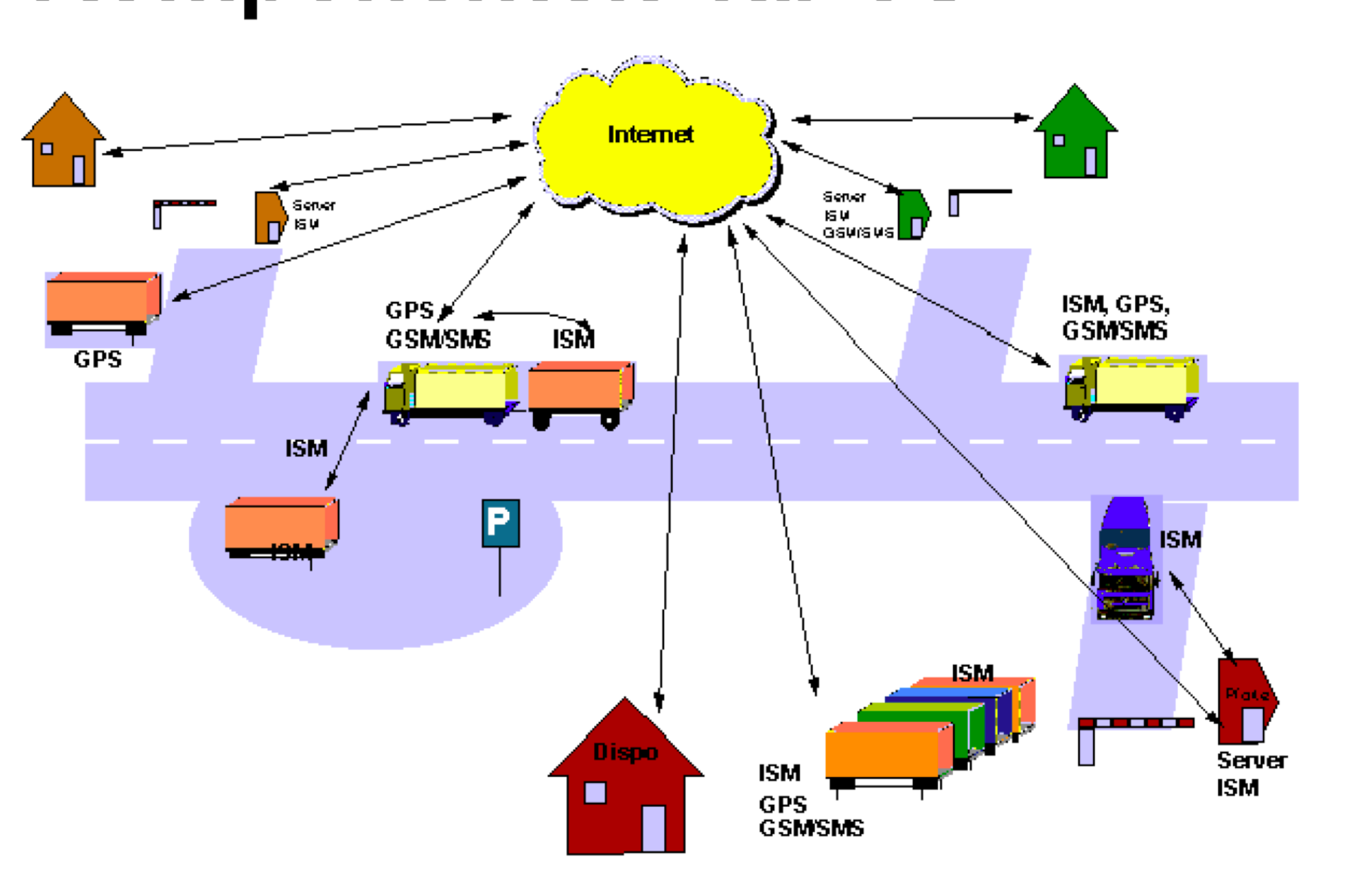
The architecture Apple would ship in 2021
Not every swap body needed expensive GPS and GSM hardware. The key insight was mesh communication: equip some units with satellite navigation and GSM data transmission, and give the rest a cheap ISM radio beacon. The beacons broadcast their serial number every few seconds. Any nearby GPS-equipped unit picks up those signals, attaches its own position, and relays everything via GSM to a central database.
Sound familiar? That is exactly how Apple’s AirTag network works — billions of iPhones acting as relay stations for cheap Bluetooth beacons. Same principle. Twenty-three years earlier. For logistics instead of lost keys.
The system had:
- ISM beacons with microcontroller, accelerometer and fuzzy logic for movement profiling
- GPS/GSM master units that collected nearby beacon signals and transmitted position data
- Stationary receivers at depots with internet uplink
- A web-based position display — in 1998, when “web-based” still meant something
- Voice-activated phone queries — call a number, enter a container ID via DTMF, hear the location spoken back
I built working prototypes of every component. A three-week field test with a real logistics company delivered positive results. The industry working group — cross-cooperation, involving major German logistics networks — was enthusiastic.
Then reality happened
The technology worked. The market existed. The demand was confirmed. What did not exist was venture capital culture in late-1990s Germany. And before I could even properly pursue funding, I ran into a more fundamental problem.
The Arbeitnehmererfindungsgesetz
German law has a provision called the Employee Invention Act (Arbeitnehmererfindungsgesetz). In principle, any invention you create — even in your spare time — may belong to your employer if it touches their field of activity. My employer built systems for aerospace and defence. TaPos used GPS, radio communication and embedded systems. The overlap was enough to create legal uncertainty.
This did not mean ELEKLUFT claimed the invention. But it meant I could not simply file patents or found a company without their explicit release. The administrative overhead and legal ambiguity alone were enough to slow everything down at exactly the moment when speed mattered.
The law has not changed much since. It remains one of Germany’s quiet innovation killers — not because employers are malicious, but because the uncertainty it creates is enough to stop engineers from even trying.
The patent lawyer who knew about bird cages
I visited a patent lawyer at one of those open consultation days that were supposed to help inventors. I explained the system: GPS positioning, ISM mesh communication, GSM data relay, internet-based tracking.
He had no idea what I was talking about. His expertise was in mechanical patents — locks, hinges, bird-cage mechanisms. He nodded politely and suggested I should “perhaps write it down more clearly.”
I left. That was the end of my patent strategy.
What it taught me
TaPos was a technical success and a commercial failure. Not because the technology was wrong — Apple proved the architecture works at planetary scale — but because:
-
Germany’s innovation infrastructure was not built for systems engineers with side projects. The support ecosystem assumed either academic research or corporate R&D. A radar engineer building IoT prototypes on weekends did not fit any category.
-
Legal frameworks designed to protect can also paralyse. The Employee Invention Act creates a chilling effect that is worse than any actual claim would be.
-
Timing without capital is just a head start you cannot use. Being right about the architecture 23 years early means nothing if you cannot get from prototype to product.
-
Build everything yourself is a strength and a trap. I designed the hardware, wrote the firmware, built the database, created the web interface, even designed the antenna placement. That meant I understood every layer. It also meant I was one person doing the work of a team.
These lessons have not changed much in 28 years. Germany still struggles with the same structural barriers to hardware innovation. The Arbeitnehmererfindungsgesetz still exists. Patent consultation for technology inventors is still inadequate. And the reflex to build perfect prototypes before seeking capital — instead of the other way around — is still deeply German.
The parallel to today
I now work with organisations where technology is mission-critical. The pattern-recognition that let me see the TaPos architecture in 1998 is the same skill I apply today — whether it is diagnosing why a system is down, designing an AI workflow that survives production, or seeing where a technology landscape is heading before the client does.
The difference is that today I do not need venture capital. I need a client with a real problem and the willingness to solve it properly. That turns out to be a much better business model.
TaPos was designed in 1997-1998 as a side project while I was employed at ELEKLUFT GmbH, Bonn. The NRW state funding application was submitted and funding had already been allocated — but the money was diverted to a mobile internet café for women, a joint project of T-Systems and the Federal Ministry for Education, Family, Seniors, Women and Youth. The project was not commercialised. Apple introduced AirTag in April 2021.