Kim Was an AI Agent a Year Before OpenClaw
Everyone is talking about agentic AI. OpenClaw — the open-source framework formerly known as Clawdbot, then Moltbot — lets an AI agent plan multi-step tasks, remember your preferences across sessions, and execute autonomously on your own machine. It connects to external language models like GPT or Claude, and the tech press treats it as a breakthrough.
It is a good project. But the core idea is not new.
Kim has been doing this since 2024. A full year before OpenClaw appeared under any of its names.
What Kim does — and has been doing
Kim is a locally operated AI system that processes documents, generates reports, performs research, and automates text workflows. It runs on an Apple Mac Mini or Mac Studio inside your own network. Your data never leaves your premises.
The interface is deliberately simple: you send Kim an email. The subject line is the instruction. Kim processes the request autonomously and returns the result.
Examples:
- “Check this text for errors and improve it” — Kim reviews spelling, grammar, style, and returns a corrected version as DOCX or PDF.
- “Compare these two documents and summarise the differences” — Kim highlights deviations and delivers a structured summary.
- “Search for information about renewable energy regulation” — Kim performs web research with full report generation and source citations.
- “Write an article about supply chain resilience” — Kim produces a well-researched draft on your topic.
No chat window. No prompt engineering. No context that disappears after closing a tab.
The architecture that makes this work
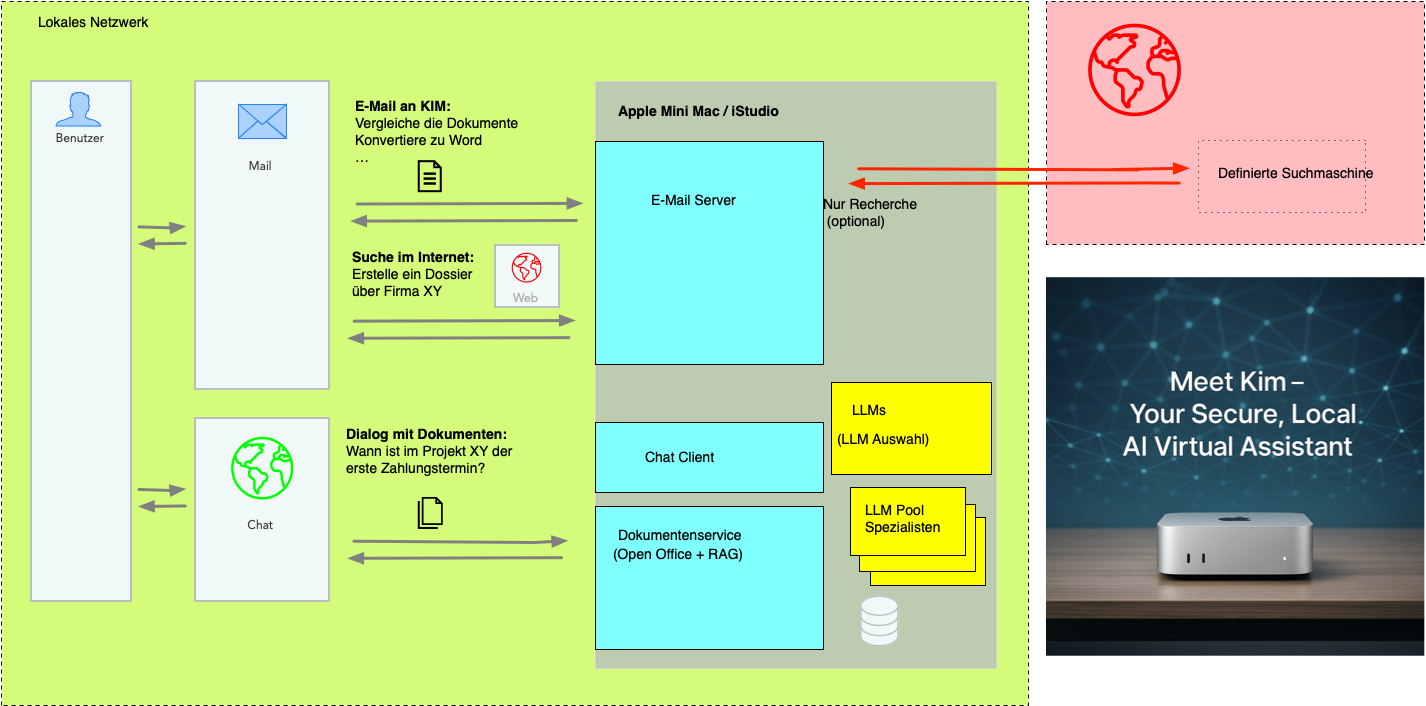
Kim is built around a local email server, a local LLM running on Apple Silicon, and a document processing pipeline. The system can function entirely offline — in that mode, the web search feature is disabled. When an internet connection is available, external access remains filtered and controlled.
This is the same principle that OpenClaw now promotes: an agent with persistent context, running on your own hardware. Kim simply got there first — and added something OpenClaw does not have: a complete document processing pipeline with format conversion, watermarking, and multi-language support built in.
Why local matters more than ever
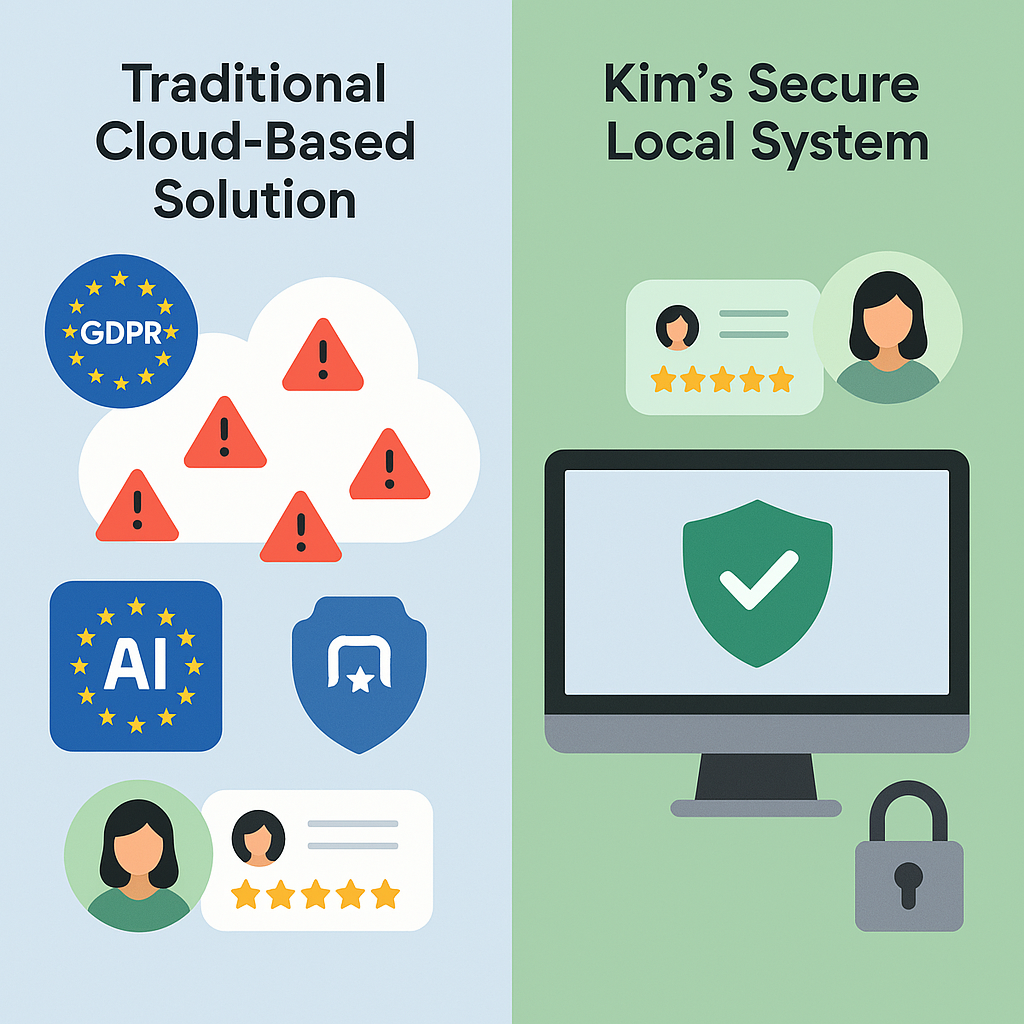
Every document you send to a cloud AI service leaves your control. It may be used for training. It may be stored in a jurisdiction with different privacy rules. It may be breached. For organisations handling contracts, personnel files, legal documents, or patient data, that is not a theoretical risk — it is a compliance problem.
Kim eliminates this entirely. The LLM runs on hardware you own. The documents stay in your network. There is no API call to an external service unless you explicitly enable web search — and even then, your documents are never transmitted.
This is not a feature. It is the architecture.
What OpenClaw gets right — and what it misses
OpenClaw deserves credit for making agentic AI accessible as open source. Its persistent memory, multi-step planning, and local execution model are sound engineering decisions.
But OpenClaw is a framework. It gives you building blocks. You still need to wire them together, connect a language model, build your workflows, and handle your own document processing.
Kim is a working system. Email in, result out. Document review, comparison, summarisation, conversion, research, article generation — all operational. On hardware that draws 30 watts, runs silently, and fits on a shelf.
The pattern repeats
In 1998, I built a GPS/ISM/GSM tracking system that anticipated Apple AirTag by 23 years. The technology worked. The market was not ready.
Kim follows the same pattern. A working local AI agent system, built a year before the concept became fashionable. The difference this time: the market is ready. Organisations are actively looking for ways to use AI without surrendering their data. The regulatory environment — GDPR, AI Act, sector-specific compliance — demands exactly the architecture Kim already provides.
Kim is not a software product. It is an implementation service. I set up the infrastructure, adapt the workflows to your organisation, and hand over a working system. Learn more about Kim or get in touch.